
Below are images from Season One of the BBC America series "COPPER". Created by Tom Fontana and Will Rokos, the series stars Tom Weston-Jones, Kyle Schmid and Ato Essandoh:
"COPPER" SEASON ONE (2012) Photo Gallery


"LOST" RETROSPECT: (5.02) "The Lie"
Season Five of ABC's "LOST" has always struck me as the series' Odd Man Out. It is not the first season to break the rules of the series' format. Season Four not only featured flashbacks, but also flash forwards. But Season Five seemed to be all over the place. And I believe this was due to the cast being split up for the first half of its season.
Before I talk about the season's second episode, (5.02) "The Lie", I feel I should do a recap of what led to its events. As many of the show's fans know, at least five of the original Oceanic Flight 815 survivors made it off the island. They were Dr. Jack Shephard, Kate Austen, Sayid Jarrah, Sun-Hwa Kwon, and Hugo "Hurley" Reyes. Five others inhabitants also managed to leave - including Claire Littleton's son Aaron, who was born on the island; Desmond Hume, who had been stranded on the island for three years; former Others leader Benjamin Linus, who left around the same time as the Oceanic survivors; Frank Lapidus, an airline pilot who had been hired to join an expedition traveling to the island aboard a freighter called the Kahana; and John Locke, whose later departure would be revealed in details in a future episode. The Season Four finale, (4.12 - 4.14) "There's No Place Like Home", viewers discovered that the original five survivors, Desmond and young Aaron were floating in a Zodiac raft, when they were picked up by a yacht owned by Desmond's love, Penny Widmore. While Desmond and Frank remained aboard Penny's yacht; Jack, Kate, Sayid, Sun, Hurley and young Aaron arrived on Fiji with a cover story about Oceanic 815's crash and how they ended there. They became known as "the Oceanic Six".
The first half of Season Five seemed to be divided into two major time period. The episodes and scenes featuring the survivors back on the island are set during the time following the Oceanic Six's departure from the island and how they dealt with the various inhabitants they encountered, while flashing back and forth through time. Rather confusing . . . eh? The episodes and scenes featuring the Oceanic Six focused on their lives nearly three years after being off the island and Benjamin Linus' efforts to get them to return. "The Lie" continued the story of the Oceanic Six during the latter period of those three years and the efforts of the island castaways to survive the constant shifts in time, which seemed to have caused a good deal of upheaval for them.
In this particular episode, Hurley finds himself labeled as a fugitive, when the police blame him for the deaths of two men whom Sayid had killed in the previous episode, (5.01) "Because You Left". With a barely conscious Sayid as his companion, Hurley appears at the Reyes family home and seeks refuge from the police with his parents. During his stay, he reveals to the latter the truth behind the lies concocted by Jack Shephard for the media and Oceanic Airlines. Meanwhile, Jack, who is forced to deal with withdrawal symptoms, and Ben try to round up the other Oceanic Six members and John Locke for their return to the island. According to former Other and island inhabitant, Eloise Hawking, Ben has seventy (70) hours to get them on a plane for the South Pacific. In the previous episode, two men had approached Kate for a blood sample to determine Aaron Littleton's bloodline. Fearful that Aaron might be taken away from her, Kate decides to go on the run with the toddler. However, a visit from Sun-Hwa Kwon prevents her from doing so. And when Kate tells her about the two men, Sun suggests that she takes excessive steps to prevent them from taking Aaron.
"The Lie" also featured the further adventures of those castaways left behind. Unlike those who had managed to leave the island, their story is set two to three years earlier - following Ben Linus and the Oceanic Six's departure. "Because You Left" revealed that when Ben left by turning that Frozen Donkey Wheel inside the DHARMA Orchid Station, those left behind found themselves flashing back and forth through time. In "The Lie", the remaining castaways attempt to start a fire at the old beach camp. Daniel, who had instructed a past Desmond Hume to find Eloise Hawking, join the others before they are attacked by the Others with a barrage of flaming arrows. Fortunately for James "Sawyer" Ford and Juliet Burke, John Locke comes to their rescue before they can be killed.
Wow! That seemed a lot for one particular episode. Was "The Lie" supposed to part of a two-part episode with "Because You Left"? If not, one could easily describe this episode as convoluted. There seemed to be at least three . . . perhaps four-story arcs going on. At least a few of the episode's story arcs seemed to relate to its title. Hurley and Sayid's stay at the Reyes home and the former's confession to his mother about the lies Jack had concocted for the media and Oceanic Airlines seemed to be one. I could also say the same about the story arc featuring Kate's anxiety over losing Aaron. And Daniel did fail to tell Sawyer and Juliet that he had instruct the past Desmond to pay a visit to Eloise Hawking. The episode's title seemed to suggest there were consequences in the Oceanic Six's lies about their survival of the Flight 815 crash, their time on the island and return to civilization. But honestly, these consequences only seemed apparent in two story arcs - Hurley's survival guilt and Kate's anxiety over losing Aaron.
The consequence of Oceanic Six's lies seemed to stem in the episode's flashback aboard Penny Widmore's yacht, where Jack presented the story, he planned to tell Oceanic Airlines and the media. There were two very interesting reactions to his revelations. Hurley seemed very reluctant to accept Jack's lies, making it clear that he found them unnecessary. But . . . being Hurley, he caved in from Jack's pressure to accept the false story for them to tell Oceanic Airlines and spent the next three years being haunted by his decision and the lies, until he finally confessed them to his mother. Another interesting reaction to Jack's suggestion came from Kate, who seemed unusually quick to accept it. Did Kate believe that his suggestion enabled her to pretend to be Aaron's mother? This seemed rather surprising to me when "LOST" was still on the air, considering that between the time she helped Claire Littleton give birth to Aaron in (1.20) "Do No Harm" and Oceanic Six's flight from the island in (4.14) "There's No Place Like Home, Part III", Kate had expressed very little interest in Claire or Aaron. Yet, nearly three years later found Kate willing to flee from Los Angeles with Aaron, due to her fear that the courts would have a legal reason to take him away from her. These two-story arcs seemed to have the strongest connections to the episode's title.
However, I had trouble making any connections between the Oceanic Six's lies and the other story arcs. If there were any connections, they struck me as a bit weak - in the case of Ben's visit to Eloise Hawking and the butcher shop that was holding Locke's body, or barely non-existent - the remaining survivors' travails with time traveling. Mind you, I found both story arcs fascinating. Ben's visit with Ms. Hawkings eventually played out in a near future episode. And the story arc surrounding those left behind on the island proved to be action-filled and very exciting. But again, their story arcs seemed to have a stronger connection to the island incidents in "There's No Place Like Home" than the Oceanic Six's lies. Speaking of the latter, I do have to give Horowitz, Kitsis and director Jack Bender for injecting a good deal of mystery regarding the island inhabitants' time traveling experiences, along with both drama and action. I am sure that many viewers were on the edge of their seats over the identities of the castaways' attackers - especially the two uniformed men who tried to kill Sawyer and Juliet.
But the crux of the episode seemed to be all about the climax over Hurley's emotional dilemma over his return to Los Angeles, along with his guilt over leaving behind many of his fellow castaways. I have rather mixed feelings about this particular story arc. On one hand, I thought Hurley's confession to Mrs. Reyes about the island seemed like an emotional payoff of his survivor guilt that first manifested in the flash forward scenes from the Season Four episode, (4.01) "The Beginning of the End". But Horowitz and Kitsis undermined this emotional payoff by having Hurley turning himself in to the authorities, after Ben Linus confronted him about returning to the island. What was the point of that? Ben gave him the opportunity to finally return to the island and put his mind at ease over leaving some of his fellow castaways behind . . . and "poof" . . . he decides to ignore Ben's offer? Even after Ana-Lucia Cortez's ghost had warned him to avoid the police?
There are some who believe that "The Lie" is an unevenly paced episode. Perhaps. I thought the episode featured too many story arcs. And if it was supposed to be the second half of a two-part episode, I wish that show runners Carlton Cuse and Damon Lindehof had not given the two episodes different titles . . . with different themes. Their actions only left me in a conundrum over whether "The Lie" is a two-part episode or not. Regardless, the opening episodes of Season Five struck me as unevenly handled, despite some very memorable scenes and performances, especially from Jorge Garcia.


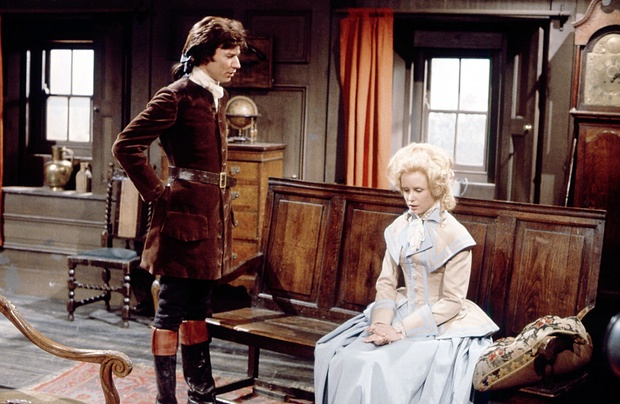
"POLDARK" SERIES ONE (1975): EPISODES ONE TO FOUR
Several years ago, I had tried a stab at the first episode of the 1975-1977 series, "POLDARK", which starred Robin Ellis. After viewing ten minutes of theatrical acting and dated photography in Episode One on You Tube, I gave up.
Last summer, I read all of the hullaballoo surrounding this new adaptation with Aidan Turner in the lead. Utilizing Netflix, I tried my luck again with the 1975 series and ended up enjoying the first four episodes (I have yet to watch any further episodes) and quite enjoyed it. I enjoyed both versions so much that I took the trouble to purchase both the entire 1975-77 series and the 2015 series. In fact, I have decided to watch both versions simultaneously. But I am here to discuss the first four episodes of the 1975 series.
Series One of "POLDARK", which first aired in 1975, is based upon Winston Graham's first four novels in the saga - 1945's "Ross Poldark: A Novel of Cornwall, 1783-1787", "Demelza: A Novel of Cornwall, 1788-1790" (1946), 1950's "Jeremy Poldark: A Novel of Cornwall, 1790-1791" and 1953's "Warleggan" (Poldark). Episodes One to Four seemed to be an adaptation of the first novel. The series begins with a young Ross Poldark returning home to Cornwall following military service with the British Army during the American Revolution. Ross spent the last year or two as a prisoner-of-war, unaware that he had been declared dead. He learns from a fellow coach passenger and later, his father's solicitor that Joshua Poldark had died financially broke. More bad news follow with Ross' discovery that his Uncle Charles Poldark had promised to sell his estate Nampara to the banking family, the Warleggans. And lady love, Elizabeth Chynoweth, had become engaged to Charles' son, his cousin Francis, after receiving news of his "death". The only possessions Ross has left are his father's estate, Nampara, which is now in ruins, two mines that had been closed for some time and two servants - the drunken Jud and Prudie Paynter - to help him work the estate. Even worse, the Warleggans, who have risen from being blacksmiths to bankers, seemed to be gaining financial control over the neighborhood. In Episode Two, Ross rescues a miner's daughter named Demelza Carne from a mob trying to use her dog Garrick as part of a vicious dogfight at a local fair. Taking pity on her, he decides to hire her as his new kitchen maid.
When I finally began to embark upon this series, I had no idea of its reputation as one of Britain's most beloved period dramas. I discovered that "POLDARK" was regarded just as highly in the 1970s, as "DOWNTON ABBEY" had become some thirty-five to forty years later. Mind you, I regard Julian Fellowes' series as the inferior series. My viewing of the first four episodes of this series made me finally appreciate why it was so highly regarded. It really is first-rate production. However . . . it had its problems. What movie or television production does not?
When it comes to an accurate adaptation of any novel or play, I tend to harbor ambiguous views on the matter. It depends upon how well it serves the story on screen or if it makes sense. Anyone familiar with Graham's novels know that the 1975 adaptation is not accurate. I had no problems with the production starting with Ross' stage journey to his home in Cornwall, considering that the novel started with a meeting between Ross' dying father and his Uncle Charles. I had no problems with Elizabeth's final reason for marrying Francis - to ensure that Charles Poldark would pay off her father's debts. This little scenario even included an interesting scene in which Ross had volunteered to use his loan for Wheal Leisure to pay off Mr. Chynoweth's debts in order to gain Elizabeth's hand in marriage. Fortunately, she stopped him from committing such a stupid act. But I had a problem with one major change and a few minor ones.
My biggest problem with these first four episodes of "POLDARK" centered on the circumstances that led Ross to marry his kitchen maid, Demelza Carne. Apparently, the series' producers and screenwriter Jack Pulman must have found Graham's portrayal of this situation hard to swallow and decided to change the circumstances leading to Ross and Demelza's marriage. In this version, Ross became drunk following his failure to prevent his former farmhand Jim Carter from being sentenced to prison for poaching. Demelza, who had been harboring a yen for Ross, decided to comfort him with sex. The following morning, Ross decided it would be better if Demelza no longer work at Nampara, so that he would not be tempted to have sex with her again. And what happened? Demelza eventually went to live with her father Tom Carne, now a religious zealot, and his new wife. She also discovered that she was pregnant. To make matter worse, Ross managed to convince his former love, Elizabeth Poldark, to leave his adulterous cousin Francis and live with him.
One, I found it very implausible that a man of Ross' station and time would marry his kitchen maid. He might sleep with her . . . yes. But marry her? A "responsible" man like Ross would have settled money upon Demelza, find a man of her class willing to accept her as a wife and the baby as his . . . or both. He would not marry her. As for Elizabeth's willingness to leave Francis for Ross . . . I really found this implausible. Elizabeth is too pragmatic to be willing to sacrifice her respectability to leave her husband for another man. Nor would she be willing to risk losing her son Geoffrey Charles, for Francis would have never allowed her to see the boy again. The only way this whole situation could have worked is if Ross had been in love with Demelza at the time. If he had, he would have never suggested that Elizabeth leave Francis for him.
There were other problems - minor problems - that I found in these first four episodes. After one night of casual sex with Demelza, Ross had decided in the following morning it would be better if she no longer work at Nampara, so that he would not be tempted to have sex with her again. And what happened? Demelza eventually went to live with her father Tom Carne, now a religious zealot, and his new wife. She also discovered that she was pregnant. To make matter worse, Ross managed to convince his former love, Elizabeth Poldark, not to leave his adulterous cousin Francis and live with him. Instead, he decided to marry the pregnant Demelza in order to save her reputation.
One, I found it very implausible that a man of Ross' station and time would marry his kitchen maid. He might sleep with her . . . yes. But marry her? A "responsible" man like Ross would have settled money upon Demelza, find a man of her class willing to accept her as a wife and the unborn baby as his own. Someone like Ross would not have married her. As for Elizabeth's willingness to leave Francis for Ross . . . I really found this implausible. Elizabeth is too pragmatic to be willing to sacrifice her respectability to leave her husband for another man. Nor would she have been willing to risk losing her son Geoffrey Charles, for Francis would have never allowed her to see the boy again. The only way this whole situation could have worked is if Ross had been in love with Demelza when he first had sex with her. If he had, he would have never suggested to Elizabeth that she leave Francis for him.
There were other problems - minor problems - that I found in these first four episodes. One episode featured Francis' violent encounter with Verity's wannabee suitor, Captain Blamey and the other, a fight between Ross and his future father-in-law, Tom Carne. And I thought Christopher Barry handled both scenes in a rather clumsy manner. Both situations seemed to be a case of "now you see it, now you don't". During Ross' fight with Carne, the 17-year-old Demelza got into the melee (which did not happen in the novel), allowing her to spout some nonsense about women's right in one of those "a woman's travails" speeches that came off as . . . well, clumsy and contrived. It did not help that actress Angharad Rees seemed to be screeching at the top of her voice at the time. In fact, screeching seemed to be the hallmark of Rees' early portrayal of the adolescent Demelza in an emotional state. Some fans have waxed lyrical over Clive Francis' portrayal of Francis Poldark. So far, I have yet to see what the big deal was about. Other than three scenes, Francis spent these first four episodes portraying a cold and rather aloof Francis. I found it difficult to get emotionally invested in the character.
Considering all of the problems I had with Episodes One-Four, one would wonder why I enjoyed "POLDARK". The series may not be perfect, but it was damn entertaining. Some have compared the production to the 1939 film, "GONE WITH THE WIND". But honestly, it reminds me of the television adaptation of John Jakes' literary trilogy, "North and South". Both the Seventies series and the "NORTH AND SOUTH" Trilogy between 1985 and 1994 share so many similarities. Both series featured their own set of flaws, entertaining melodrama, strong characterizations and a historical backdrop. In the case of "POLDARK", the historical backdrop featured Great Britain - especially Cornwall - after the American Revolution, during the last two decades of the 18th century. It is a period of which I have never been familiar - especially in Britain. I never knew that Britain's conflict with and the loss of the American colonies had such a negative impact upon the country's economic state. I had heard of the United States and France's economic struggles during this period, but I never knew about Britain's struggles. I also recently learned about the impact of the fallen tin and copper prices on Cornwall, during the 1770s and especially the 1780s. This economic struggle contributed to the slow decline of the aristocracy and the landed gentry for Cornish families like the Poldarks and the Chynoweths.
I thought this economic depression was well-handled by the production team. Not once did the producers, Barry or Pulman rush through Ross' struggles to establish a new fortune. They also took their time in conveying the struggles of nearly everyone else in the neighborhood - the other members of the Poldark family, the Chynoweths, and especially the working-class. This struggle of the working-class manifested not only Demelza's story arc, but also that of Jim and Jinny Carter in the first three episodes. This struggled boiled down to a heartbreaking moment in which Jim was caught poaching on a local estate and sentenced to prison - despite Ross' futile efforts to help him. I noticed that although the Warleggan family loomed menacingly in the background, only one member had made at least two appearances in these first four episodes - Nicholas Warleggan. The most famous member of the family - George Warleggan - had yet to make an appearance.
And despite my complaints about the situation that led to Ross and Demelza's marriage, I must admit that the emotional journey of Ross and the other leading characters managed to grab my attention. Being familiar with Graham's novel, I am well aware that Ross' return, Elizabeth's decision to marry Francis, Ross' meeting with Demelza, the marital fallout between Elizabeth and Francis and Ross' inability to get over losing Elizabeth will have consequences down the road. I have to admit that "POLDARK" did a pretty damn good job in setting up the entire saga . . . despite a few hiccups. I found it interesting that Episode One solely featured Ross' return and his emotional reaction to Elizabeth's decision to marry Francis. He did not even meet Demelza until Episode Two.
These first four episodes also set up a conflict between Demelza and Elizabeth. I have mixed feelings about this. Personally, I rather liked how Debbie Horsfield managed to set up a quasi-friendship between the two women in the new adaptation. But since Demelza and Elizabeth were probably doomed not to be friends, I see that screenwriter Jack Pulman decided to immediately go for the jugular and set up hostilities between the pair. In Episode Three, a jealous Demelza had maliciously blamed Elizabeth for Francis' infidelity, even though she had yet to meet the pair. I found this even more ironic, considering the episode also featured a minor scene in which Elizabeth actually made an attempt to emotionally reach out to Francis. He rejected her due to an assignation with some prostitute. And the whole scenario regarding Ross' suggestion that Elizabeth leave Francis and Demelza's pregnancy boiled down to a long scene in which Ross informed Elizabeth of the situation and her angry reaction. Which included calling Demelza a whore. By the end of Episode Four, Pulman and Barry had firmly established hostility between the two women.
Much has been said about the series' exteriors shot in Cornwall. Yes, they looked beautiful, wild and almost exotic for Great Britain. Not even the faded photography can hide the beauty of the Cornish landscape. I also found John Bloomfield's costume designs very attractive, but not exactly mind blowing. Also, a few of the costumes for actress Jill Townsend seemed a bit loose - especially in the first two episodes. As for the series' score written by Kenyon Emrys-Roberts . . . not exactly memorable.
I might as well come to the performances featured in Episodes One to Four. Overall, I found them pretty solid. Although I came away with the feeling that some of the cast members and director Christopher Barry thought "POLDARK" was a stage play. Yes, I found some of the performances a bit theatrical. And I have to include some of the main cast members. I have always liked the Charles Poldark character - not because he was likable. I simply found him rather colorful. And I thought actor Frank Middlemass did an excellent job in conveying this aspect of Mr. Poldark Senior. Jonathan Newth gave a solid, yet intense performance as the barely volatile Captain Blamey. Both Paul Curran and Mary Wimbush gave very colorful performances as Ross' slothful servants, Jud and Prudie Paynter. And yet, some of that color threatened to become very theatrical. On the other hand, Stuart Doughty gave a solid and subtle performance as Ross' former servant-turned-miner, Jim Carter. I could also say the same for Jillian Bailey, who portrayed Jim's wife, Jinny. By the way, fans of the 1983 miniseries, "JANE EYRE" should be able to spot Zelah Clarke (a future Jane Eyre) in a small role as one of the stagecoach passengers in the opening scene of Episode One.
There has been a great deal of praise for Angharad Rees' portrayal of Demelza Carne, Ross' kitchen maid and soon-to-be wife. And yes, I believe she earned that praise . . . at least in the second half of Episode Three and all of Episode Four. I found her performance very lively and when the scene demanded it, subtle. I thought she was outstanding in the scene that featured Demelza's seduction of Ross. However, she was at least thirty or thirty-one when she portrayed Demelza in Series One. And her portrayal of a Demelza in early-to-mid adolescence struck me as loud and over-the-top. Thankfully, the screeching ceased in the second half of Episode Three. Clive Francis' portrayal of Francis Poldark struck me as somewhat subdued or a bit on the cold side - except in two scenes. One of them featured Francis' near death inside the Wheal Leisure mine, when he feared Ross would allow him to drown. Another featured his confrontation with Captain Blamey, the sea captain who became romantically interested in Francis' sister Verity. In both cases, the actor came off as a bit theatrical. But I thought his performance in Episode Four, which featured Elizabeth's announcement that she would leave Francis, seemed more controlled, yet properly emotional at the same time.
If I have to give awards for the best two performances in these first four episodes, I would give them to Jill Townsend as Elizabeth Chynoweth Poldark and Norma Streader as Verity Poldark. It seemed to me they were the only two members of the cast who managed to avoid any theatrical acting in any of their scenes. Even when their characters were in an emotional state. One of Streader's finest moments occurred in Episode Two, when she expressed her feelings about Captain Blamey in a conversation with her cousin Ross. Despite expressing Verity's emotions in a fervent manner, Streader still managed to maintain control of her performance. For me, Townsend's finest moments occurred throughout Episode Four. From the moment Ross suggested that Elizabeth leave Francis for good, Townsend conveyed Elizabeth's emotional journey throughout this episode - from surprise to hopeful to desperation, relief, happiness, disbelief, anger and finally bittersweet disappointment. I may not have approved the producers' decision to include a scene featuring Demelza's pregnancy and Elizabeth's decision to leave Francis. But dammit, Townsend acted her ass off and gave the best performance from the entire cast during this particular sequence. One of her best scenes featured a one-on-one conversation with Streader's Verity.
I have seen actor Robin Ellis in other movie and television productions, including 1971's "SENSE AND SENSIBILITY" and 1981's "THE GOOD SOLDIER". If I were to pick his best roles, I would choose two - the passive aggressive American John Dowell in "THE GOOD SOLDIER" and of course, Ross Poldark. The producers of the series selected the right actor to portray the volatile war veteran-turned-mine owner from Graham's saga. He is Ross Poldark . . . of the 1970s that is. Granted, Ellis had his moments of theatrical acting. There were times during the first four episodes in which I had to turn down my television volume. But despite this, I thought he did an excellent job in capturing all aspects - both good and bad - of his character's personality. Two scenes featuring his performance caught my attention. Ellis seemed a bit scary and intense when he expressed Ross' reaction to being rejected by Elizabeth Chynoweth in Episode One. And I thought he gave a poignant performance in the scene that featured Demelza's seduction of Ross.
There you have it . . . my impression of the first four episodes from the 1975 series, "POLDARK". So far, this adaptation of the first novel in Winston Graham's literary series had its share of flaws. But I feel that its virtues overshadowed the former. In fact, I found myself so captivated by Episodes One to Four that I feel more than ready to continue this saga. Onward to Episode Five!


BANOFFEE PIE While watching an episode of the British television series, "THE SUPERSIZERS . . ." , one particular dish caught my...


